This site is intended for US healthcare professionals only.

Request a Rep

This site is intended for U.S. healthcare professionals only.

glove punching through rubble

Make the FIRST move—
understanding METex14+

Starting with a MET inhibitor for patients with METex14+ mNSCLC is critical for maximal benefit.1

Up to 4% of patients with mNSCLC harbor METex14 skipping alterations2

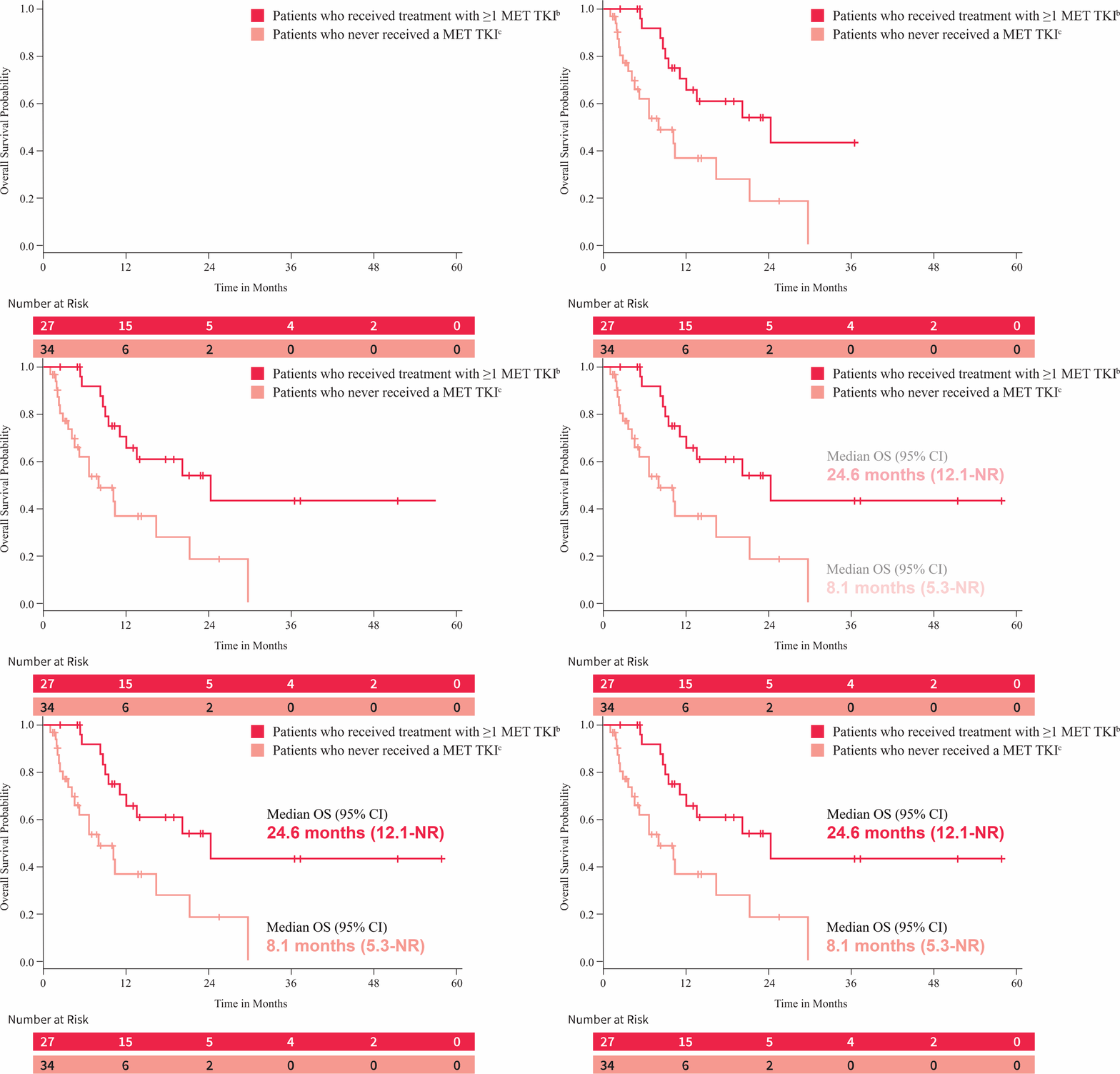
Real-world studies demonstrated poor outcomes in patients with METex14 skipping who never received a MET inhibitor1,3,a

Real-world METex14 outcomes graph

aIn a retrospective analysis using data from 12 institutions, 61 patients with METex14+ NSCLC met the inclusion criteria for survival analysis. Among these 61 patients, 34 never received treatment with a MET TKI.1

bOverall survival of 27 patients with stage IV METex14+ NSCLC who received treatment with at least one MET TKI.1

cOverall survival of 34 patients with stage IV METex14+ NSCLC who never received a MET TKI.1

16.5 months

Patients who start with a MET TKI experience a longer OS than those who do not1,3

What could targeted treatment FIRST mean for your patients?

Tap to zoom in

Test for METex14+ at diagnosis to help guide treatment decisions1

MOLECULAR PROFILING

  • Test for METex14+ upon diagnosis or when a patient presents with metastatic NSCLC. When you test, consider broad molecular profiling that includes MET alterations.1

TESTING METHODS

  • METex14+ may be accurately detected through NGS or PCR-based testing. In the VISION trial, METex14+ was identified through either PCR or NGS testing.4,d

National Comprehensive Cancer Network® (NCCN®) recommends5:

 
  • Clinicians obtain molecular testing results for actionable biomarkers before administering first-line ICI therapy, if clinically feasible
  • If a METex14+ skipping mutation is discovered during first-line systemic therapy, interrupt current therapye and start a MET inhibitor

dSome patients tested positive using both methodologies.4

eIf there is a good response to current therapy, the NCCN considers it reasonable to continue that therapy.5

Real-world studies demonstrated poor outcomes in patients with METex14 skipping who never received a MET inhibitor1,3,a

Real-world METex14 outcomes graph

aIn a retrospective analysis using data from 12 institutions, 61 patients with METex14+ NSCLC met the inclusion criteria for survival analysis. Among these 61 patients, 34 never received treatment with a MET TKI.1

bOverall survival of 27 patients with stage IV METex14+ NSCLC who received treatment with at least one MET TKI.1

cOverall survival of 34 patients with stage IV METex14+ NSCLC who never received a MET TKI.1

16.5 months

Patients who start with a MET TKI experience a longer OS than those who do not1,3

What could targeted treatment FIRST mean for your patients?

Test for METex14+ at diagnosis to help guide treatment decisions1

MOLECULAR PROFILING

  • Test for METex14+ upon diagnosis or when a patient presents with metastatic NSCLC. When you test, consider broad molecular profiling that includes MET alterations.1

TESTING METHODS

  • METex14+ may be accurately detected through NGS or PCR-based testing. In the VISION trial, METex14+ was identified through either PCR or NGS testing.4,d

National Comprehensive Cancer Network® (NCCN®) recommends5:

 
  • Clinicians obtain molecular testing results for actionable biomarkers before administering first-line ICI therapy, if clinically feasible
  • If a METex14+ skipping mutation is discovered during first-line systemic therapy, interrupt current therapye and start a MET inhibitor

dSome patients tested positive using both methodologies.4

eIf there is a good response to current therapy, the NCCN considers it reasonable to continue that therapy.5

Dr. Shu on METex14+ identification and treatment considerations

0:44 – Impact of METex14+
2:16 – NCCN Recommendations
Explore efficacy results

INDICATION

TEPMETKO is indicated for the treatment of adult patients with metastatic non-small cell lung cancer (NSCLC) harboring mesenchymal-epithelial transition (MET) exon 14 skipping alterations.

SUMMARY OF WARNINGS AND PRECAUTIONS

TEPMETKO is associated with the following Warnings and Precautions: interstitial lung disease (ILD)/pneumonitis, hepatotoxicity, pancreatic toxicity, and embryo-fetal toxicity.

Please see additional Important Safety Information at the end of this video and the accompanying full Prescribing Information for TEPMETKO.

Dr Catherine Shu

Hi. My name is Dr Catherine Shu. I'm a thoracic oncologist based out of an academic medical center in New York, New York. I have over 8 years of experience treating patients with MET exon 14 skipping metastatic non-small cell lung cancer.

An estimated 3 to 4% of patients diagnosed with non-small cell lung cancer each year in the United States have MET exon 14 skipping alterations. These patients are associated with a poor prognosis and require a targeted treatment approach.

Approximately 65% of patients with MET exon 14 skipping alterations may be PD-L1 positive, meaning greater than or equal to 1% expression. And these patients have been found to respond poorly to standard of care.

Real-world studies demonstrated positive outcomes in patients with MET exon 14 skipping who received at least one MET TKI.

The Kaplan-Meier Curves shown on this chart demonstrate a difference in median overall survival for patients with stage IV non-small cell lung cancer, harboring MET exon 14 alterations, who received treatment with at least one MET TKI versus patients with MET exon 14 skipping non-small cell lung cancer who never received a MET TKI. Those patients who received a MET TKI had a much longer median overall survival of approximately 2 years, while patients who never received a MET TKI had a median overall survival of approximately 8 months.

Because MET exon 14 skipping is a primary oncogenic driver, it plays an important role in oncogenesis in some cases of non-small cell lung cancer.

NCCN Guidelines strongly recommend that clinicians test for actionable biomarkers in eligible patients with metastatic non-small cell lung cancer. This recommendation can help identify MET exon 14 skipping alterations at diagnosis and inform treatment decisions.

One of the most important parts of diagnosis is to make sure that every lung adenocarcinoma patient gets full next-gen sequencing testing. And that’s so important because we have to be able to test for molecular alterations like MET exon 14. This is because the treatments obviously differ. And the patients with MET exon 14 are different than patients with other alterations.

The NCCN Non-Small Cell Lung Cancer Panel has stratified its preferences for the first-line therapy options for patients with MET exon 14 skipping mutation-positive metastatic non-small cell lung cancer. These are also recommended as subsequent therapy options if the patient was not previously treated with a MET inhibitor.

NCCN also recommends if a MET exon 14 skipping mutation is discovered during the first-line systemic therapy, interrupt the current therapy and start a MET inhibitor, although if there is a good response to current therapy, the NCCN considers it reasonable to continue that therapy.

Tepotinib is an NCCN Category 2A-preferred regimen for first-line and subsequent line setting for patients with MET exon 14 skipping metastatic non-small cell lung cancer.

Please continue watching for Important Safety Information for TEPMETKO.

MET signaling and targeted inhibition

MET pathway signaling6

  • Depending on the cellular context, activated MET signaling may induce processes including cell proliferation, motility, and apoptosis
  • MET alterations like METex14+ skipping or MET amplification lead to a dysregulation of MET signaling
  • Dysregulated MET signaling may lead to tumor cell proliferation, migration, and survival
Tap to zoom in

TEPMETKO MOA4

  • TEPMETKO is an oral inhibitor that targets MET tyrosine kinase activity, including aberrant activity observed with METex14 skipping alterations
  • In vitro, TEPMETKO inhibits tumor cell proliferation, anchorage-independent growth, and migration of MET-dependent tumor cells
Tap to zoom in

MET pathway signaling6

  • Depending on the cellular context, activated MET signaling may induce processes including cell proliferation, motility, and apoptosis
  • MET alterations like METex14+ skipping or MET amplification lead to a dysregulation of MET signaling
  • Dysregulated MET signaling may lead to tumor cell proliferation, migration, and survival
Tap to zoom in

TEPMETKO MOA4

  • TEPMETKO is an oral inhibitor that targets MET tyrosine kinase activity, including aberrant activity observed with METex14 skipping alterations
  • In vitro, TEPMETKO inhibits tumor cell proliferation, anchorage-independent growth, and migration of MET-dependent tumor cells
Tap to zoom in
Razelle Kurzrock, MD, FACP

By identifying these [METex14+] alterations, we can promptly initiate treatment with appropriate targeted therapy.

— Razelle Kurzrock, MD, FACP

Discover the support and resources available for you and your patients

AKT=Ak strain transforming; c-Cbl=Casitas B lineage lymphoma; CI=confidence interval; ERK=extracellular signal-regulated kinase; ICI=immune checkpoint inhibitor; JAK=Janus kinase; MET=mesenchymal-epithelial transition; METex14=mesenchymal-epithelial transition exon 14; METex14+=mesenchymal-epithelial transition gene exon 14 skipping alterations; mNSCLC=metastatic non-small cell lung cancer; NCCN=National Comprehensive Cancer Network; NGS=next-generation sequencing; NR=not reached; NSCLC=non-small cell lung cancer; OS=overall survival; PCR=polymerase chain reaction; PI3K=phosphoinositide 3-kinase; RAS=rat sarcoma virus; STAT=signal transducer and activator of transcription; TKI=tyrosine kinase inhibitor.