
This site is intended for US healthcare professionals only.

Request a Rep

This site is intended for U.S. healthcare professionals only.

glove punching through rubble

An established safety profile1

The safety and tolerability of TEPMETKO were established in 313 patients1

Most adverse reactions observed in the VISION trial were mild to moderate (Grade 1 or 2)1

ARs in ≥10% of patients with mNSCLC harboring METex14+a
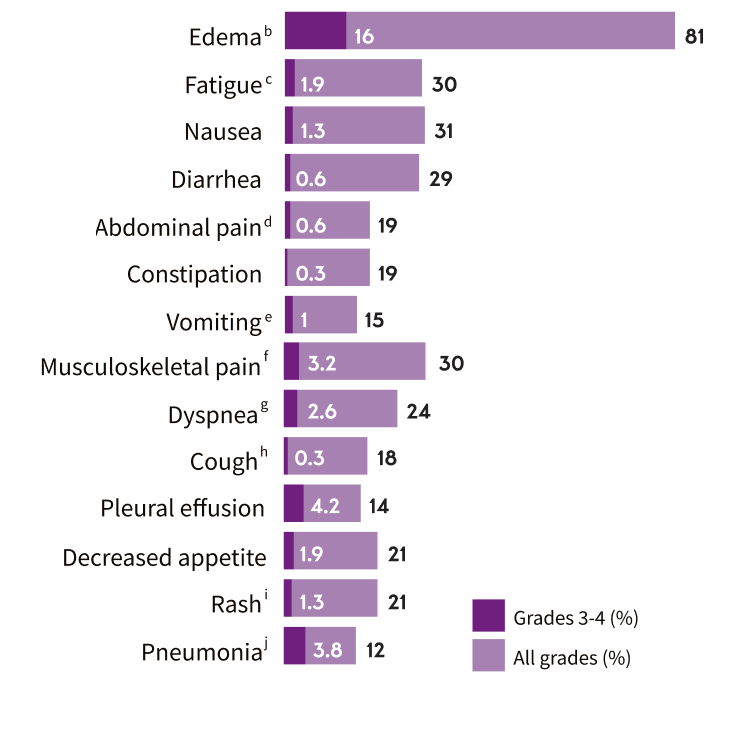
adverse reactions chart
  • Fatal adverse reactions occurred in 1.9% of patients who received TEPMETKO, including pneumonitis (0.3%), hepatic failure (0.3%), dyspnea from fluid overload (0.3%), pneumonia (0.3%), sepsis (0.3%), and death of unknown cause (0.3%)1 
  • Serious adverse reactions occurred in 51% of patients who received TEPMETKO. Serious adverse reactions in >2% of patients included pleural effusion (6%), pneumonia (6%), edema (5%), general health deterioration (3.8%), dyspnea (3.5%), musculoskeletal pain (2.9%), and pulmonary embolism (2.2%)1

See additional safety information in the next tab.

aSeverity as defined by National Cancer Institute Common Terminology Criteria for Adverse Events (NCI CTCAE) version 4.03.1
bEdema includes eye edema, face edema, generalized edema, localized edema, edema, genital edema, peripheral edema, peripheral swelling, periorbital edema, and scrotal edema.1
cFatigue includes asthenia and fatigue.1
dAbdominal pain includes abdominal discomfort, abdominal pain, abdominal pain lower, abdominal pain upper, gastrointestinal pain, and hepatic pain.1
eVomiting includes retching and vomiting.1
fMusculoskeletal pain includes arthralgia, arthritis, back pain, bone pain, musculoskeletal chest pain, musculoskeletal pain, myalgia, non-cardiac chest pain, pain in extremity, and spinal pain.1
gDyspnea includes dyspnea, dyspnea at rest, and dyspnea exertional.1
hCough includes cough and productive cough.1
iRash includes rash, palmar-plantar erythrodysesthesia syndrome, rash maculo-papular, eczema, exfoliative rash, rash erythematous, rash pustular, skin exfoliation, dermatitis acneiform, drug eruption, dermatitis, rash pruritic, dermatitis bullous, toxic skin eruption.1
jPneumonia includes pneumonia, pneumonia aspiration, and pneumonia bacterial.1
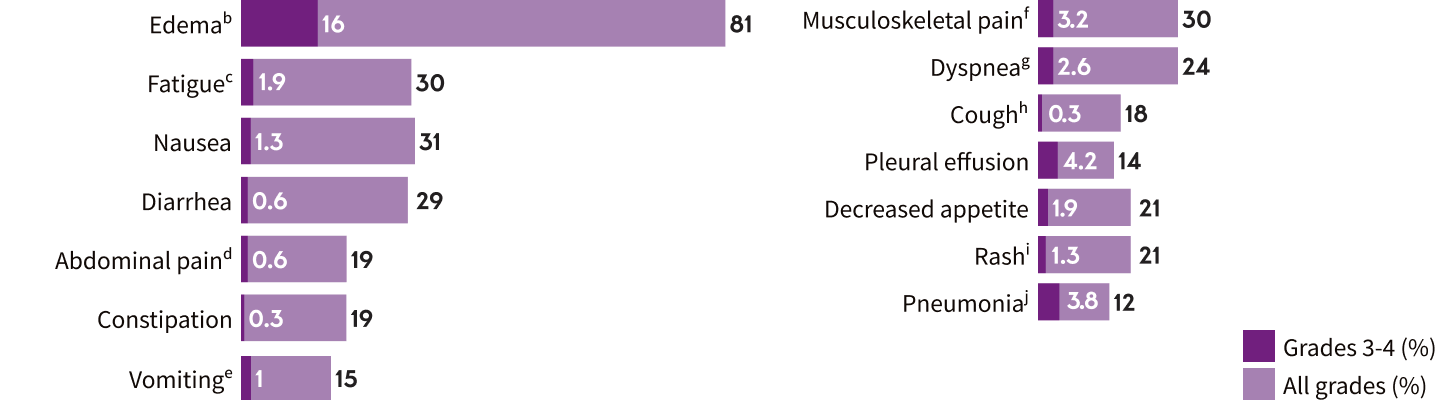

Laboratory abnormalities1,a,k
  • Selected laboratory abnormalities (≥20%) from baseline in patients receiving TEPMETKO in descending order were: decreased albumin (81%), increased creatinine (60%), decreased lymphocytes (57%), increased ALP (52%), increased ALT (50%), increased AST (40%), decreased sodium (36%), decreased hemoglobin (31%), increased GGT (29%), increased potassium (26%), increased amylase (25%), decreased leukocytes (25%), decreased platelets (24%), and increased lipase (21%)
  • The most common Grade 3-4 laboratory abnormalities (≥2%) in descending order were: decreased lymphocytes (15%), decreased albumin (9%), decreased sodium (9%), increased GGT (6%), increased amylase (5%), increased lipase (5%), increased ALT (4.9%), increased AST (3.6%), and decreased hemoglobin (3.6%)
Treatment modifications due to an AR in patients who received TEPMETKO1
  • Dosage interruptions (53%): ARs which required dosage interruption in >2% of patients who received TEPMETKO included edema (28%), increased blood creatinine (6%), pleural effusion (3.5%), nausea (3.2%), increased ALT (2.9%), pneumonia (2.6%), decreased appetite (2.2%), and dyspnea (2.2%)
  • Dose reductions (36%): ARs which required dose reductions in >2% of patients who received TEPMETKO included edema (22%), increased blood creatinine (2.9%), fatigue (2.2%), and pleural effusion (2.2%)
  • Permanent discontinuation (25%): The most frequent adverse reactions (>1%) leading to permanent discontinuations of TEPMETKO were edema (8%), pleural effusion (1.6%), and general health deterioration (1.6%)

aSeverity as defined by National Cancer Institute Common Terminology Criteria for Adverse Events (NCI CTCAE) version 4.03.1
kThe denominator used to calculate the rate varied from 268 to 309 based on the number of patients with a baseline value and at least one posttreatment value.1

Most adverse reactions observed in the VISION trial were mild to moderate (Grade 1 or 2)1

ARs in ≥10% of patients with mNSCLC harboring METex14+a
adverse reactions chart
  • Fatal adverse reactions occurred in 1.9% of patients who received TEPMETKO, including pneumonitis (0.3%), hepatic failure (0.3%), dyspnea from fluid overload (0.3%), pneumonia (0.3%), sepsis (0.3%), and death of unknown cause (0.3%)1 
  • Serious adverse reactions occurred in 51% of patients who received TEPMETKO. Serious adverse reactions in >2% of patients included pleural effusion (6%), pneumonia (6%), edema (5%), general health deterioration (3.8%), dyspnea (3.5%), musculoskeletal pain (2.9%), and pulmonary embolism (2.2%)1

See additional safety information in the next tab.

aSeverity as defined by National Cancer Institute Common Terminology Criteria for Adverse Events (NCI CTCAE) version 4.03.1
bEdema includes eye edema, face edema, generalized edema, localized edema, edema, genital edema, peripheral edema, peripheral swelling, periorbital edema, and scrotal edema.1
cFatigue includes asthenia and fatigue.1
dAbdominal pain includes abdominal discomfort, abdominal pain, abdominal pain lower, abdominal pain upper, gastrointestinal pain, and hepatic pain.1
eVomiting includes retching and vomiting.1
fMusculoskeletal pain includes arthralgia, arthritis, back pain, bone pain, musculoskeletal chest pain, musculoskeletal pain, myalgia, non-cardiac chest pain, pain in extremity, and spinal pain.1
gDyspnea includes dyspnea, dyspnea at rest, and dyspnea exertional.1
hCough includes cough and productive cough.1
iRash includes rash, palmar-plantar erythrodysesthesia syndrome, rash maculo-papular, eczema, exfoliative rash, rash erythematous, rash pustular, skin exfoliation, dermatitis acneiform, drug eruption, dermatitis, rash pruritic, dermatitis bullous, toxic skin eruption.1
jPneumonia includes pneumonia, pneumonia aspiration, and pneumonia bacterial.1
Laboratory abnormalities1,a,k
  • Selected laboratory abnormalities (≥20%) from baseline in patients receiving TEPMETKO in descending order were: decreased albumin (81%), increased creatinine (60%), decreased lymphocytes (57%), increased ALP (52%), increased ALT (50%), increased AST (40%), decreased sodium (36%), decreased hemoglobin (31%), increased GGT (29%), increased potassium (26%), increased amylase (25%), decreased leukocytes (25%), decreased platelets (24%), and increased lipase (21%)
  • The most common Grade 3-4 laboratory abnormalities (≥2%) in descending order were: decreased lymphocytes (15%), decreased albumin (9%), decreased sodium (9%), increased GGT (6%), increased amylase (5%), increased lipase (5%), increased ALT (4.9%), increased AST (3.6%), and decreased hemoglobin (3.6%)
Treatment modifications due to an AR in patients who received TEPMETKO1
  • Dosage interruptions (53%): ARs which required dosage interruption in >2% of patients who received TEPMETKO included edema (28%), increased blood creatinine (6%), pleural effusion (3.5%), nausea (3.2%), increased ALT (2.9%), pneumonia (2.6%), decreased appetite (2.2%), and dyspnea (2.2%)
  • Dose reductions (36%): ARs which required dose reductions in >2% of patients who received TEPMETKO included edema (22%), increased blood creatinine (2.9%), fatigue (2.2%), and pleural effusion (2.2%)
  • Permanent discontinuation (25%): The most frequent adverse reactions (>1%) leading to permanent discontinuations of TEPMETKO were edema (8%), pleural effusion (1.6%), and general health deterioration (1.6%)

aSeverity as defined by National Cancer Institute Common Terminology Criteria for Adverse Events (NCI CTCAE) version 4.03.1
kThe denominator used to calculate the rate varied from 268 to 309 based on the number of patients with a baseline value and at least one posttreatment value.1

Peripheral edema was observed with TEPMETKO and can be managed1-3

Compensatory management of peripheral edema included2:

elevated leg
Limb elevation
leg compression
Compression stockings
decreased salt intake
Dietary salt reduction
two capsules
Diuretics

In VISION, edema was managed with2:

capsule in target
Dose reduction
clock in target
Temporary interruption
hand in target
Discontinuation
Refer to the full Prescribing Information for guidance on dose modifications.
  • TRAEs due to peripheral edema occurred in 67.1% of patients, with 11.2% experiencing Grade 3 or higher instances3
  • Proactive monitoring for peripheral edema is recommended2
  • TEPMETKO can be dose reduced in one step from two 225-mg tablets (450 mg total) to one 225-mg tablet1
Robert Hsu, MD

While edema may impact a patient's quality of life,
I find that it can be managed with supportive care.

— Robert Hsu, MD

TEPMETKO patient support kit.

A support kit is available to help your patients navigate their TEPMETKO treatment.

Review the dosing and administration for TEPMETKO

ALP=alkaline phosphatase; ALT=alanine aminotransferase; AR=adverse reaction; AST=aspartate aminotransferase; GGT=gamma-glutamyl transferase; METex14+=mesenchymal-epithelial transition gene exon 14 skipping alterations; mNSCLC=metastatic non-small cell lung cancer; TRAEs=treatment-related adverse events.